

The Ministry of Education and Training issued Circular No. 95/2026/TT-BGDĐT introducing fundamental changes to university admissions starting in 2027. The new regulations reduce admission methods, cap certificate bonus points, and promote synchronized online data utilization.
On November 13, 2026, the Ministry of Education and Training officially announced the new catalog of admission methods along with Circular No. 95/2026/TT-BGDĐT amending and supplementing regulations on university admissions and training1,3. This document takes effect on November 11, 2026, introducing major adjustments to standardize the admission process, reduce quota fragmentation, and increase the use of digital database systems3,4. This document directly impacts the enrollment plans of universities as well as the study orientations of high school students nationwide1,4.

Photo: USAID, Ministry of Education and Training Sign First MOU to Expand Cooperation on Improving Quality of Vietnamese Higher Education – USAID Vietnam, Public domain, via Wikimedia Commons.
Streamlining Methods in the 2027 University Admission Regulations
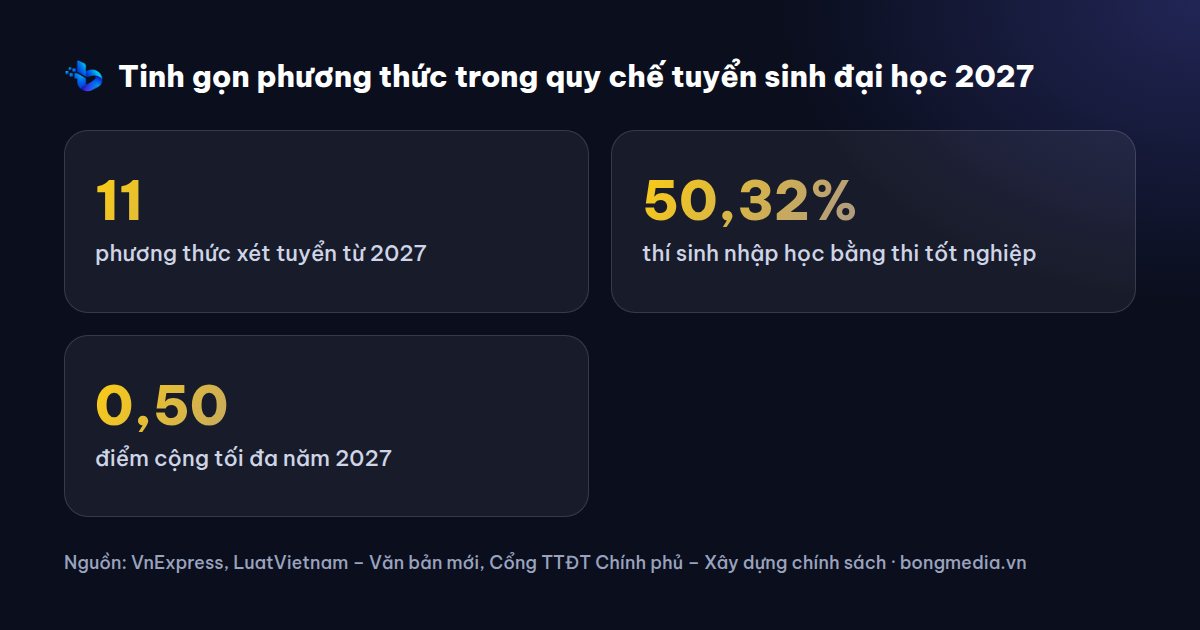
According to the announcement from the regulatory agency, the catalog of university admission methods applied from 2027 has been shortened from 19 to 11 methods1. Forms combining high school graduation exam scores with interviews, transcripts, or international certificates that were previously scattered have been grouped under code 600 named "Use of combined methods"1. Universities have the right to determine the admission components and component weights, but must ensure equal participation conditions for candidates1,3.

Photo: Epernay-moet-orangerie(1) – Palauenc05, CC BY-SA 4.0, via Wikimedia Commons.
The new regulations also set a ceiling limit on the number of methods that each university and each major is allowed to operate3. Specifically, each training institution is only allowed to apply a maximum of 5 admission methods (excluding direct admission and prioritized admission)1,4. At the level of individual majors or training programs, regulations allow a maximum of 3 methods in 2027 and will continue to be tightened to 2 methods from 20281,4.
According to recorded data for 2025, the high school graduation exam score admission method still accounts for a dominant proportion with 50.32% of enrolled students, while the transcript review method ranks second with over 29%1. In addition, Circular No. 95/2026/TT-BGDĐT requires that each method only have a single admission score scale and mandates public transparency of scoring rules3,4. The document also adds the group of learners who graduated from vocational high schools to the right to register for admission to training programs in the same group of majors3,4.
Controlling Bonus Point Ceilings and Phase-out Roadmap from 2028
One of the adjustments receiving significant attention is the regulation on incentive points and bonus points4,5. Training institutions that have applied achievement bonus points, national excellent student awards, or international certificates (such as IELTS, SAT) from 2026 and earlier are allowed to maintain them in the 2027 admission season, however, the total bonus point level is capped at a maximum of no more than 0.50 points on a 30-point scale4,5. Schools must have specific explanatory documents if they continue to use this bonus point policy4.

Photo: Artemis I Award Certification Ceremony (KSC-20220812-PH-ILW01 0148) – Isaac Watson, Public domain, via Wikimedia Commons.
The 0.50 point ceiling marks a sharp decrease compared to the maximum bonus of 3/30 points in previous admission seasons4,5. Statistics from last year showed that more than 37,300 candidates used English certificates to receive bonus points, among which the group of candidates achieving IELTS 6.0 accounted for more than 8,300 students but were once converted by schools into 26 different score levels, causing inconsistency among institutions5.
The Ministry of Education and Training has set a roadmap: starting in 2028, universities will completely stop using bonus points in admissions4,5. Despite this, the regulations do not prohibit converting international foreign language certificate scores into foreign language subject scores in subject combinations if the school's admission plan allows it5.
Digitizing Admission Processes and Connecting National Data
Circular No. 95/2026/TT-BGDĐT sets thorough requirements for utilizing digital infrastructure in receiving and processing applications4. Schools must connect with the General Admission Data System and the National Population Database to simplify administrative procedures for learners4.

Photo: Jerry Nadeau – Photographer PA3 KIMBERLY WILDER, Public domain, via Wikimedia Commons.
The regulations clearly state that training institutions do not have the right to demand candidates to provide additional papers, applications, degrees, or certificates whose information is already valid on the shared digital database, except in cases where data is missing or special verification requests arise4. At the same time, the document strictly prohibits schools from collecting any additional admission application fees beyond the rates implemented through the Ministry's General Admission System4.
For internal management activities, determining enrollment quotas is linked to teaching hour quota data and evidence of lecturer income through the digital data system4. For postgraduate education levels, recipients of Government scholarships under Decree No. 179/2026/NĐ-CP are required to study full-time and must not work full-time at another unit during the training period4.
Vizy's take
According to Vizy, the Ministry of Education and Training's move to tighten admission regulations is not simply a matter of cutting technical quotas, but an effort to clean up the excessive complexity of the admission landscape over the past years. The fact that a single foreign language certificate was once interpreted into 26 different bonus score scales shows the fragmentation of standards and undermines transparency in talent selection. By pulling the bonus point ceiling down to 0.5 points before completely eliminating it by 2028, regulators are gradually re-establishing the benchmark status of core competency assessment exams.
From the perspective of technology and digital policy operations, Vizy believes that the regulation banning requirements to resubmit digitized papers and banning additional fees outside the general system is a positive signal showing determination in data interoperability. When population data and electronic academic transcripts are seamlessly integrated, procedural pressure on candidates will decrease significantly. Universities are forced to shift from the race of "fishing for applications" through multiple complex methods to investing substantially in program quality and the transparency of admission algorithms.
Sources
- VnExpress – Công bố 11 phương thức tuyển sinh đại học từ năm 2027 (2026-11-13)
- LuatVietnam – Văn bản mới – Quyết định 5049/QĐ-UBND của Ủy ban nhân dân tỉnh An Giang về việc phê duyệt Quy trình nội bộ tiếp nhận và giải quyết thủ tục hành chính lĩnh vực An toàn thực phẩm không phụ thuộc vào địa giới hành chính (phi địa giới hành chính) thuộc thẩm quyền giải quyết của Sở Y tế tỉnh An Giang (Năm, 12 Th)
- Cổng TTĐT Chính phủ – Xây dựng chính sách – Quy định mới về tuyển sinh và đào tạo cao đẳng ngành Giáo dục mầm non, đại học, sau đại học (2026-11-13)
- Tuổi Trẻ – Tuyển sinh đại học 2027: Mỗi ngành tối đa 3 phương thức xét tuyển, điểm cộng không quá 0,5 (2026-11-13)
- VnExpress – Giảm mạnh điểm cộng IELTS, bỏ hẳn từ năm 2028 (2026-11-13)
Compiled and analysed by Vizy from the sources above and reviewed by a Bống Media editor before publication. "Vizy's take" is the author's own opinion. For information only, not investment advice.
FAQ
From 2027, how many admission methods is each university allowed to apply?
Each training institution is allowed to use a maximum of 5 admission methods, while each individual program or major is only allowed a maximum of 3 methods in 2027 and decreases to 2 methods from 2028.
How do bonus points for IELTS certificates or excellent student awards change?
In 2027, the total maximum bonus points are limited to no more than 0.50/30 points instead of 3/30 points as before, and starting in 2028, this bonus point policy will be officially and completely abolished.
Are universities allowed to collect additional admission fees outside the general system?
Training institutions are strictly prohibited from collecting any additional admission application fees under any form from candidates applying through the General Admission System.