


Microsoft recently experienced a widespread service disruption lasting over 24 hours, severely impacting essential applications like Outlook, Teams, and Copilot. Although systems are gradually recovering, the incident has disrupted operations for governments, hospitals, and businesses in more than 70 countries.
Microsoft's cloud service system experienced a severe global Microsoft outage starting Thursday morning (November 12, 2026), causing widespread disconnections for tools such as Microsoft 365, Outlook, Teams, and Copilot that lasted for over 24 hours1,4. This incident spread across more than 70 countries, paralyzing operations for public agencies, hospitals, and businesses worldwide1,2,4. Representatives of the corporation publicly apologized to users while confirming that the root cause stemmed from an internal technical error rather than a cyberattack or artificial intelligence (AI)3,4,5.

Photo: Microsoft Redmond Campus redevelopment aerial view, Sept. 2021 – Atomic Taco, CC BY-SA 2.0, via Wikimedia Commons.
Causes and Progression of the Global Microsoft Outage
Initial reports of the service disruption began appearing on the Downdetector tracking portal around noon Eastern Time on Thursday, with nearly 83,000 outage reports for Outlook alone at 1:00 PM1,4. This situation rapidly spread from North America to Europe and the Asia-Pacific region1,4,5. Not only productivity software, but even Microsoft's own status update page went down until around 3:00 PM on the same day1.

Photo: EFTA00002518 - Server rack with multiple hard drives and network cables connected in a data center environment – Federal Bureau of Investigation, Public domain, via Wikimedia Commons.
Regarding the cause, Microsoft stated that the incident occurred during a prior network capacity upgrade and manifested following a recent network configuration change3,4,5. Automated server health check procedures forced several server clusters offline, resulting in congested traffic and overloading the remaining infrastructure1,2,5. Australian Minister for Home Affairs Tony Burke cited Microsoft's explanation, noting that the event shared similarities with the CrowdStrike update incident in July 2024 when a technical update encountered glitches1,5.
By late Friday (November 13, 2026), Microsoft stated that recovery was progressing favorably in Asia-Pacific, Europe, and North America, but acknowledged there was still no specific estimated time of arrival (ETA) for completion as engineers had to address each region sequentially and clear email queues1,2,5. To prevent data loss, the company extended the email delivery queue retention period to up to 48 hours4,5.
Impact Level and Notable Figures
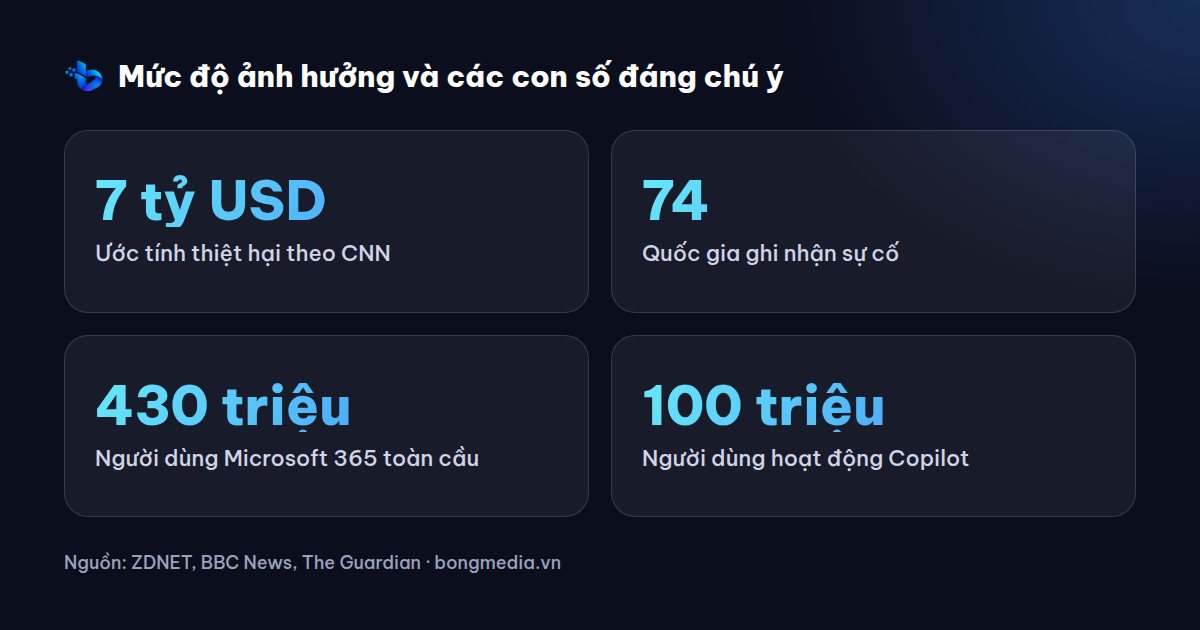
The aftermath of this system crash reflects the deep reliance of the global economy on Microsoft's digital services2,3. A consulting organization speaking with CNN estimated that this disruption caused economic damages of up to $7 billion USD1.

Photo: Building92microsoft – Coolcaesar, CC BY-SA 4.0, via Wikimedia Commons.
- Over 70 countries impacted: Data from Downdetector recorded 74 countries with users reporting widespread connection errors for Microsoft 365 services1.
- Massive user scale: There are currently about 430 million Microsoft 365 users globally according to BBC figures, while Microsoft's January statistics recorded over 450 million commercial paid accounts, alongside more than 100 million monthly active users of the Copilot toolset reported in 20251,2,5.
- Paralyzed public agencies: The email systems of the US House of Representatives and Australian intelligence agencies were both interrupted, while the court system in Singapore was directly affected2. In Arapahoe County, Colorado (USA), the local detention facility had to temporarily suspend processing online bail payments for inmates because the Outlook notification system was disabled3.
- Healthcare and transportation disruptions: The UK National Health Service (NHS) recorded severe disruption as staff were unable to access the NHS.net Connect system, forcing many hospitals to revert to paper medical records3. The incident also caused disruptions at airline support counters in India2, while Air India adopted a temporary measure of redirecting emails to maintain passenger correspondence reception5.
- Delayed financial disclosures: Swiss luxury group Richemont delayed reporting its business results, while electric truck manufacturer Workhorse Group postponed its third-quarter financial report schedule to November 16, 2026, due to related operational glitches5.
Despite the large-scale technical incident disrupting multiple industries, Microsoft shares on Wall Street rose slightly by 0.2% during Friday's trading session amid mixed broader stock market conditions3,5.
Expert and Stakeholder Opinions
Flora Hamilton, CEO of the Small Business Charter, noted that the event serves as a clear lesson on the degree of reliance that small and medium-sized enterprises place on digital systems like Outlook to communicate with customers and generate revenue2.

Photo: NJ Tech Council CIO Conference in Parsippany May 2016 – Jonathan Schilling, CC BY-SA 4.0, via Wikimedia Commons.
From a technology perspective, former senior software engineer Gergely Orosz remarked that while such disruptions are not unprecedented, the nearly one-day restoration time is unusual, suggesting that providers should decouple services independently by region similar to Amazon Web Services' (AWS) architecture to minimize cascading risks2. Meanwhile, AI strategy expert Walter Pasquarelli warned that as AI virtual assistants become more deeply embedded in email, calendars, and document data, infrastructure incidents like this will cause even more widespread consequences in the future2.
James Owen, Director of Digital Risk at consulting firm Control Risks, pointed out that this situation exposes a resilience challenge built over decades as organizations depend on a very small group of technology vendors5. He recommended that businesses proactively build manual backup plans, internet-free operational processes, and diversify their service provider partnerships5.
Vizy's take
According to Vizy, this incident is not merely a routine server operational glitch, but continues to pose a challenging question regarding centralized infrastructure architecture for enterprises. When hundreds of millions of users globally place all communication flows, storage, and AI assistant tools into a single cloud provider, a localized technical configuration glitch is enough to turn into a cross-border operational crisis within hours.
For the business community in Vietnam, this incident serves as an important warning signal in technology risk management. Many domestic units currently run nearly 100% of their office work through Microsoft 365 while lacking backup scenarios when connection lines are disrupted. Vizy believes that corporate leaders should soon establish detailed business continuity plans (BCP): setting up independent emergency communication channels, storing offline backups for confidential documents, and considering a multi-cloud model to ensure organizations are not completely paralyzed when major tech companies experience outages.
Sources
- ZDNET – Microsoft doesn’t ‘have an ETA for full recovery’ on outage yet (2026-11-13)
- BBC News – Microsoft outage 'stark reminder' of how much we rely on tech (Fri, 13 No)
- The Guardian – Microsoft ‘deeply sorry’ for disruption affecting millions and says it’s ‘not related to cyber or AI’ – as it happened (2026-11-13)
- Wired – Microsoft 365 Crawls Back to Life After a 24-Hour Outage (2026-11-13)
- CNBC – Microsoft apologizes for massive outage that took down Outlook and other 365 services (2026-11-12)
Compiled and analysed by Vizy from the sources above and reviewed by a Bống Media editor before publication. "Vizy's take" is the author's own opinion. For information only, not investment advice.
FAQ
What caused the global Microsoft outage?
According to Microsoft, the outage stemmed from issues arising during network capacity upgrades and configuration changes, causing automated health checks to disconnect certain servers and overload the remaining infrastructure, entirely unrelated to cyberattacks or AI.
Which Microsoft services were affected during this disruption?
The incident caused widespread disruptions across Microsoft 365 cloud services, most notably the Outlook email system, Teams collaboration application, Copilot virtual assistant, and storage platforms like SharePoint and OneDrive.
What did Microsoft do to protect unsent emails during the network outage?
Microsoft extended the email queue timeout window to up to 48 hours so systems could continue attempting to resend all delayed mail, ensuring emails stuck during the downtime reached recipients once systems recovered.