

Apple is showing a major shift in its development direction as its device lineup becomes increasingly fragmented and complex compared to its traditional minimalism. Alongside hardware restructuring to encourage users to choose higher-priced versions, the company is also beginning to test limited usage models and recurring fees for artificial intelligence features. These adjustments reflect intense pressure from rising component costs and the challenge of commercializing AI technology.
Apple is noticeably shifting its product strategy by moving away from a streamlined philosophy to establish a complex device matrix alongside layered pricing mechanisms4. This move comes as the American tech giant faces pressure to maintain growth, rising memory chip costs, and the race to commercialize artificial intelligence (AI) utilities4. These adjustments in hardware, software, and services are causing significant disruptions to the shopping habits of tech consumers4.

Photo: Retina Display – Haotian0905, Public domain, via Wikimedia Commons.
Apple changes strategy through a complex hardware matrix
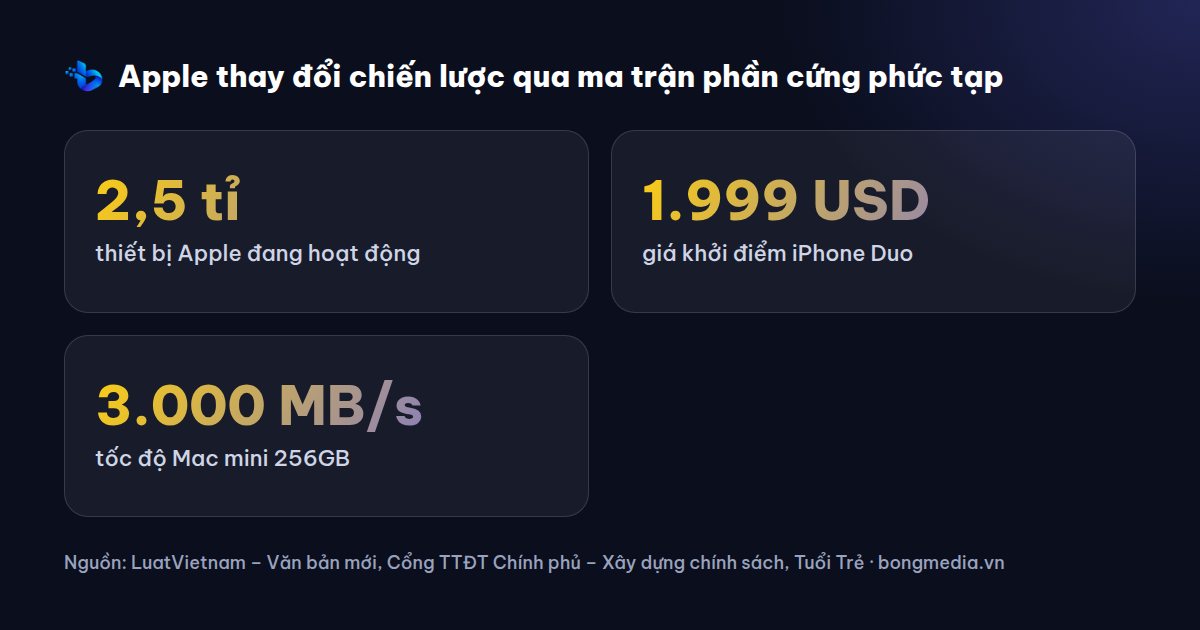
Apple's ecosystem has now surpassed the milestone of 2.5 billion active devices globally4. Unlike the 1997–1998 period when Steve Jobs cut 70% of the product roadmap to bring the entire Mac computer line down to a minimalist four-square grid, today's device lineup requires customers to study detailed specifications for each model4.
This fragmentation is clearly evident across several key product lines:
- Apple Watch Series 12: The company offers three casing materials: aluminum (starting at $399), titanium ($699), and ceramic; however, the processor configuration, sensor system, display, and battery capacity of all three versions are completely identical4.
- AirPods 5: Divided into two separate price points of $129 and $1494.
- iPad mini OLED: Announced to support a maximum 6-core CPU, but the two storage versions of 128GB and 256GB only feature a 5-core CPU; customers wanting the full 6-core chip version are forced to pay for the 512GB model4.
- Mac mini 256GB version: Because it uses only a single NAND memory chip, its read and write speeds stop at around 3,000 MB/s, half that of the 512GB version in a context where SSD hard drives are permanently soldered to the board4.
- iPhone Duo: The company's first foldable phone has a starting price of up to $1,999, more expensive than the iPhone 18 Pro Max yet lacking a dedicated telephoto camera, LiDAR sensor, ProRAW image format, Action button, and Face ID system4.
- iPhone 18 Pro series: In the US market, the 18 Pro and 18 Pro Max versions use two different types of modem chips despite belonging to the same Pro generation4. Starting from the 17 Pro line, Apple has transitioned from a unibody titanium frame to a segmented glass-and-aluminum composite frame, equipped with up to 5 physical buttons and significantly heavier than the Galaxy S26 Ultra4.
Feature bundling strategy and component cost pressures
Alongside configuring smaller steps, Apple applies a bundling method combining the technologies users need with the features the company wants to push4. A prime example is the newly launched MacBook Pro OLED: users wanting an OLED screen and Dynamic Island are forced to pay starting from $2,899 (compared to $1,999 for the standard version) and accept the accompanying touch feature without an option to opt out4. To accommodate the touch screen on a laptop, the company had to redesign the hinge to limit vibration and add an anti-vibration mechanism for the camera during touch operations4.
In the home space, device prices have also risen sharply4. The new Apple TV 4K now comes only in a single 128GB version integrating an Ethernet port using the A19 chip priced at $299, completely eliminating lower-priced options4. A combo consisting of the 128GB Apple TV and a pair of HomePod minis previously priced at $350, now with the new generation (HomePod mini 2 priced at $149, up from $99 for its predecessor) brings total costs to $6004. Official iPhone Duo silicone cases priced at $79 also note the necessity of using adhesive to secure them to the device body4.
Apple's Chief Financial Officer acknowledged that the company's profit margins are being eroded by rising memory chip prices4. This is also the direct factor causing the selling price of the iPhone 18 Pro to increase by $1004.
In the high-end hardware segment, the folding iPhone Duo weighs 254 grams, a difference of about 53 grams (approximately 25% heavier) than the 201-gram Galaxy Z Fold 84. This foldable device has experienced screen cracking along the vertical hinge and dust ingress during durability tests; Apple confirmed these faults on a small number of units and applied a replacement policy without disclosing specific causes4. Additionally, its inner screen coated with a nano-texture layer causes blacks to look hazy gray, and the Split View multitasking feature is locked at a fixed 50/50 ratio4.
Apple Intelligence services and turn-based AI charging models
Apple's approach to artificial intelligence has also seen setbacks compared to its usual practice of introducing fully finished products4. When announcing Apple Intelligence, the company posted notices that the utility was "available now," yet in reality many features were delayed for months, forcing US advertising watchdogs to issue corrective recommendations4. Apple simultaneously had to pull an ad video for the personalized Siri assistant and acknowledge that upgrading Siri requires more time than expected4.
The consequences of delayed software completion left HomeView smart display units warehoused for nearly a year waiting for the virtual assistant to mature4. Although the Clean Up feature on iOS 27 has been upgraded, its ability to reconstruct complex surfaces remains slower than Galaxy AI on the Z Fold 84. Notably, the mechanism integrating ChatGPT into Siri requires users to confirm through multiple cumbersome steps; according to lawsuit filings, OpenAI representatives admitted that the volume of users switching from Siri to ChatGPT is very low4.
To offset expensive server operating costs, Apple has begun pivoting toward a turn-based AI business model4:
- Siri AI is testing a daily usage quota allocation mechanism tied to iCloud+ subscription plans4. Accordingly, accounts purchasing the 200GB tier ($2.99/month) receive twice the quota, the 2TB tier gets 5 times, and the 12TB tier ($59.99/month) gets 20 times4.
- On the professional music software Logic Pro 13, the AI assistant only grants access to subscribers of the Creator Studio package4. Customers purchasing the permanent perpetual license for $199.99 will not have this feature and, once they use up their quota, are forced to purchase an additional top-up pack valued at $49.994.
Vizy's take
According to Vizy, Apple's restructuring of its product matrix and commencement of AI commercialization show that the era of "buy once, get full access" for high-end hardware is gradually closing. As the economics of semiconductor costs and server infrastructure running large language models become increasingly expensive, tech companies are forced to find ways to shift the financial burden onto consumers through recurring subscription models and tiered pricing. Deeply intervening in basic hardware configurations such as SSD read/write speeds or cutting processor cores is a clear sign that profit margins are being prioritized above all else.
In Vietnam, Vizy believes that both individual users and small-and-medium enterprises need to change their habits when choosing tech devices. Buyers can no longer automatically assume that the cheapest version of a professional device series retains core performance. Checking detailed specification sheets before making device investment decisions is a mandatory requirement to avoid unexpected upgrade costs. At the same time, businesses utilizing the Apple ecosystem also need to prepare budgets for cloud service packages if they want to maintain working efficiency using smart tools in the future.
Sources
- LuatVietnam – Văn bản mới – Quyết định 120/2026/QĐ-UBND của Ủy ban nhân dân Thành phố Đồng Nai ban hành Quy định chức năng, nhiệm vụ, quyền hạn và cơ cấu tổ chức của Ban Quản lý dự án Đầu tư xây dựng Công trình nông nghiệp thành phố Đồng Nai (T3, 17 Thg)
- Cổng TTĐT Chính phủ – Xây dựng chính sách – Quy định chế độ, chính sách của Quân nhân, công nhân, viên chức Quốc phòng (2026-11-18)
- Tuổi Trẻ – Tân sinh viên sư phạm nhận Huân chương Lao động hạng nhất, nuôi ước mơ làm thầy giáo (2026-11-18)
- Tinh tế – Apple đã thay đổi quá nhiều, gần như đã đánh mất chính mình (Wed, 18 No)
- LuatVietnam – Văn bản mới – Quyết định 121/2026/QĐ-UBND của Ủy ban nhân dân Thành phố Đồng Nai ban hành Quy định chức năng, nhiệm vụ, quyền hạn và cơ cấu tổ chức của Ban Quản lý dự án Đầu tư xây dựng Công trình giao thông thành phố Đồng Nai (T3, 17 Thg)
Compiled and analysed by Vizy from the sources above and reviewed by a Bống Media editor before publication. "Vizy's take" is the author's own opinion. For information only, not investment advice.
FAQ
How does Apple apply the Siri AI usage limit mechanism?
Apple is testing a daily Siri AI usage quota tied to iCloud+ cloud storage plans, ranging from double the limit on the 200GB plan up to 20 times the limit for the 12TB plan.
What is the price of the iPhone Duo and what features were cut?
The iPhone Duo starts at $1,999 but lacks a dedicated telephoto camera, a LiDAR sensor, the ProRAW format, the Action button, and Face ID.
Why does the new 256GB Mac mini version have slower read and write speeds?
The 256GB Mac mini uses only a single NAND chip, resulting in read and write speeds of approximately 3,000 MB/s—half as fast as the 512GB version—and users cannot upgrade it themselves because the SSD is soldered down.