


Thị trường công nghệ trong nước đang bước vào chu kỳ vận hành thực chất khi Luật Trí tuệ nhân tạo và Chiến lược quốc gia chính thức đi vào đời sống. Doanh nghiệp và cơ quan quản lý chuyển hướng ưu tiên sang chuẩn hóa dữ liệu, bảo đảm tính toàn vẹn pháp lý và kiểm soát tỷ suất hoàn vốn.
AI Adoption in Vietnam: From Trials to Practical Operations
After years of technological exploration, AI adoption in Vietnam is witnessing a landmark shift as a series of institutional frameworks are successively issued and enforced1. On November 18, 2026, experts at the AI360 Forum pointed out that the market is shifting its focus from the number of models to practical operational capacity, resolving data barriers and return-on-investment challenges1. Concurrently, the finalization of legal regulations ranging from the handling of technological assets to digital authentication is creating a secure foundation for the national digital infrastructure2,3.

Photo: Sample view of data collection process using artificial intelligence application – Captain Andrew M. Freeman, Air Force Institute of Technology / Air Force Research Laboratories (AFRL), Sensors, ATR, Target Recognition Branch., Public domain, via Wikimedia Commons.

Photo: Legal team translate policy into action during Operation Southern Guard (8885258) – Staff Sgt. ShaTyra Reed-Cox, Public domain, via Wikimedia Commons.
Completing Legal Frameworks to Drive AI Transformation
The year 2026 is considered a pivotal milestone for domestic technology policy as the Artificial Intelligence Law officially takes effect on March 11. Subsequently, on August 28, 2026, the Prime Minister signed Decision No. 1671/QĐ-TTg approving the National Strategy on Artificial Intelligence to 2030, with a vision to 20451. The strategy sets targets for the AI economic scale to contribute about 6% of GDP, increase labor productivity by 10 - 15% in application-heavy industries, integrate AI into 100% of online public services, form at least 10 domestic AI brands, and achieve $5 billion in export revenue1.

Photo: Green Datacenter AG – Ralph Plennert, CC BY-SA 4.0, via Wikimedia Commons.
Speaking at the Vietnam - AI360 Artificial Intelligence Forum 2026 on November 18 in Hanoi, Mr. Tran Anh Tu, Deputy Director of the Department of Digital Technology and Artificial Intelligence under the Ministry of Science and Technology, emphasized that domestic enterprises are the primary force for implementing transformation1. Department leaders affirmed that AI projects must materialize into specific problems with designated beneficiaries and comply with the three-tier risk management model stipulated by law1.
Mr. Nguyen Van Khoa, Chairman of the Vietnam Software and IT Services Association (VINASA), noted: "The Law has paved the way, and the Strategy has pointed the direction. The year 2026 marks the entry of Vietnam's AI into practical operations"1. According to Mr. Khoa, the strength of domestic technology enterprises lies in their deep understanding of local languages and business operations, meeting the large-scale demands of both state agencies and small and medium-sized enterprises1.
Challenges in Data Governance and Costs for AI Adoption in Vietnam
Experience from pioneering entities shows that algorithms are no longer the biggest barrier; rather, the crux lies in data cleanliness and specialized knowledge1. Mr. Nguyen Quang Huy, Director of the Data Science and Engineering Center at Vietcombank, cited that in a 6-step bank fraud detection chain lasting about 300 milliseconds, the AI model only participates in 2 steps, while the remaining 4 steps are entirely semantic processing and data governance procedures1. If data definitions are inconsistent across departments, the AI system will amplify errors at machine speed1.
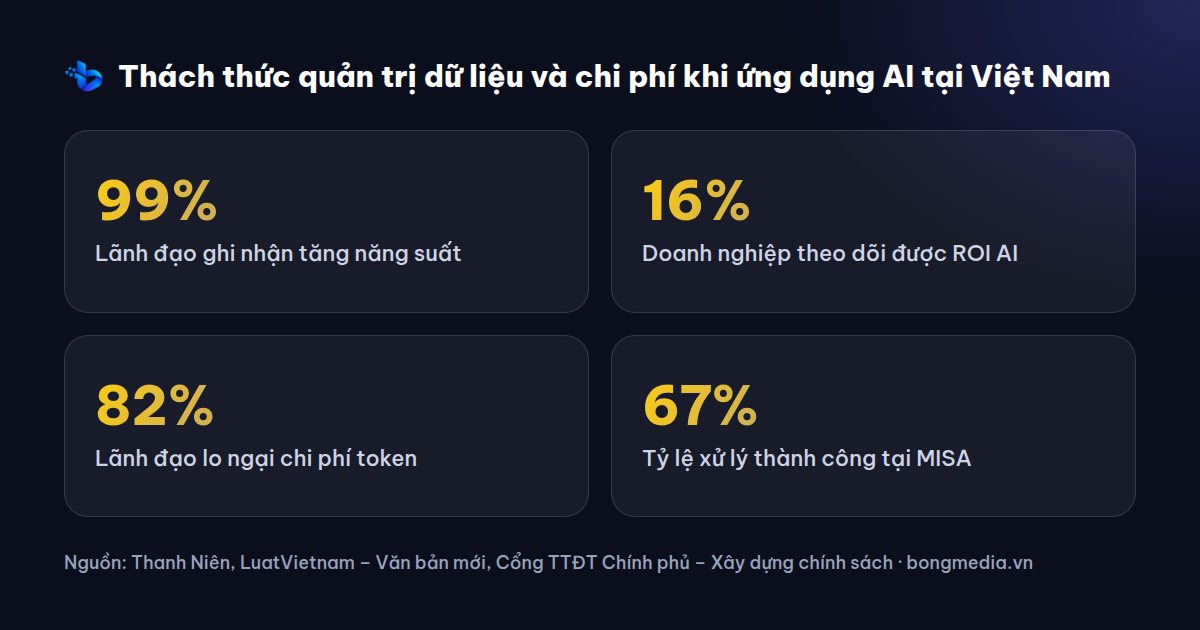
At MISA Group, Mr. Nguyen Thanh Tung, Director of the Institute of Technology Training, stated that the AVA assistant is supporting about 18,000 conversation sessions daily1. When testing began in October 2025 across 5 products, the successful processing rate reached only 23% due to fragmented business data; after a year of knowledge and scenario standardization, by October 2026, this rate reached 67% across a scale of 75 products1.
Besides data, the operating costs of computational infrastructure are placing heavy pressure on return on investment (ROI) calculations1. The October 2026 CEO Outlook survey shared by Mr. Nguyen Viet Long, Deputy CEO of EY Vietnam, shows that:
- 99% of leaders noted increased labor productivity over the past 12 months1.
- Only 16% of enterprises have the capacity to monitor comprehensive AI costs in real-time to measure ROI1.
- 82% of managers expressed concerns over token usage costs1.
- 98% of units were forced to adjust their technology approach strategy due to cost pressures, while only 64% established clear budget quotas1.
To address this pressure, a representative of FPT Smart Cloud offered three infrastructure options: enterprises self-investing in GPU clusters with a 6 - 12 month deployment time; renting GPU infrastructure; or paying flexible tokens according to actual usage demand1.
Synchronizing Digital Notarization Regulations and Preserving Technology Assets
Alongside the private sector, governments at all levels are accelerating the institutionalization of technology management1,2. Expectedly in December 2026, the Ministry of Science and Technology will issue standards for selecting and integrating virtual assistants for the public sector, focusing on information security from the data layer1.
At the local level, the People's Committee of Bac Ninh City has issued an Implementation Plan for Decision No. 1916/QĐ-TTg of the Prime Minister to execute Resolution 37/2026/QH162. Notably, the plan requires agencies to compile a first-phase review list before November 20, 2026, for cases arising before September 1, 20262. The plan clearly defines that assets being research results, software, data, and intellectual property rights related to legal cases must be preserved and exploitation conditions determined to avoid wasting digital infrastructure, separated from the personal liability of violators2.
In the digital services sector, on November 16, 2026, Deputy Prime Minister Le Tien Chau signed and issued Decree No. 413/2026/NĐ-CP amending Decree 104/2025/NĐ-CP3. The document supplements Article 47a, establishing standards for two-way conversion between paper notarized documents and electronic notarized documents, requiring the assurance of integrity, recording of conversion information, and carrying a digital signature (for electronic documents) or the signature and seal (for paper documents) of the notary along with the notarization organization3. Meanwhile, in Lam Dong, the provincial People's Committee also recently issued Decision 112/2026/QĐ-UBND on November 18, 2026, to stipulate caps on printing, copying, and typing costs serving local authentication work4.
Vizy's take
According to Vizy, the simultaneous rollout of specific regulations by ministries, sectors, and localities in November 2026 indicates that Vietnam has officially closed the phase of bandwagon AI adoption. The market has now entered an era of operation based on data discipline and legal caution. When token costs and computing infrastructure become matters of survival in financial terms, the fact that 98% of corporate leaders must reconsider their approach strategy is a positive signal, helping to weed out ineffective trial projects.
Vizy believes that for Vietnamese enterprises, rushing to follow self-built large language models can create unnecessary cost burdens. The focus at this time should be on standardizing internal data structures and choosing flexible outsourced solutions. Simultaneously, clear state regulations on the legal value of electronic notarized data and mechanisms to preserve software and data assets will serve as a secure footing for businesses to confidently disburse funds for digital transformation in the upcoming phase.
Sources
- Thanh Niên – AI tại Việt Nam chuyển dịch từ thử nghiệm sang vận hành (2026-11-18)
- LuatVietnam – Văn bản mới – Kế hoạch 418/KH-UBND của Ủy ban nhân dân thành phố Bắc Ninh thực hiện Quyết định của Thủ tướng Chính phủ ban hành Kế hoạch triển khai thi hành Nghị quyết 37/2026/QH16 ngày 24/8/2026 của Quốc hội về cơ chế, chính sách đặc thù để xử lý vi phạm pháp luật liên quan đến kinh tế Nhà nước, kinh tế tư nhân và ứng dụng khoa học, công nghệ, đổi mới sáng tạo, chuyển đổi số (Tư, 18 Thg)
- Cổng TTĐT Chính phủ – Xây dựng chính sách – Chuyển đổi văn bản công chứng giấy sang văn bản điện tử phải đáp ứng các yêu cầu nào? (2026-11-18)
- LuatVietnam – Văn bản mới – Quyết định 112/2026/QĐ-UBND của Ủy ban nhân dân tỉnh Lâm Đồng quy định mức trần chi phí in, chụp, đánh máy giấy tờ, văn bản liên quan đến việc chứng thực trên địa bàn tỉnh Lâm Đồng (Tư, 18 Thg)
Compiled and analysed by Vizy from the sources above and reviewed by a Bống Media editor before publication. "Vizy's take" is the author's own opinion. For information only, not investment advice.
FAQ
When does the Artificial Intelligence Law in Vietnam take effect?
The Artificial Intelligence Law officially takes effect and enters into force on March 1, 2026.
What are the biggest barriers businesses face when deploying AI into operations?
The biggest barriers lie in the unstandardized quality of business data and the pressure to control token costs alongside computing infrastructure.
What conditions must a converted electronic notarized document meet?
When converting from a paper notarized document to an electronic document, it must ensure content integrity compared to the original, carry conversion confirmation symbols, source information, and the digital signature of the notary along with the practicing notarization organization.